
Water is essential for human survival, and ensuring a secure and reliable water supply is of paramount importance. In Germany, the Water Security Law (Wassersicherstellungsgesetz) aims to provide emergency water supply to cities in times of crisis, ensuring the population’s uninterrupted access to clean drinking water. The law has been designed to provide a framework for local authorities to ensure that water supply can be maintained even in the face of extreme weather events, natural disasters, or other crises.
The Water Security Law stipulates that the Federal Government is responsible for equipping cities with necessary machines, devices, or pumps to ensure the uninterrupted supply of water to the population. The law emphasizes the need to provide one pump per approximately 1,500 inhabitants. This guideline is based on the assumption that a single pump can supply water to about 3,000-5,000 people, depending on the pump’s capacity and the distribution network’s design.
The law’s implementation is the responsibility of the local authorities, who must develop and maintain emergency water supply plans to ensure that the population’s water needs are met during a crisis.
The Water Security Law is just one part of the broader framework that ensures water supply security in Germany. The country has a robust water management system, which includes the Water Resources Act (Wasserhaushaltsgesetz), the Drinking Water Ordinance (Trinkwasserverordnung), and the Federal Water Act (Wasserhaushaltsgesetz). These laws regulate water use, protect water resources, and ensure that drinking water meets the highest standards of quality.
In addition to legal frameworks, Germany also has a well-established water infrastructure that provides reliable access to drinking water to its population. The country’s water supply system is decentralized, with more than 6,000 water supply companies managing the water distribution network. This decentralized system ensures that the water supply is less vulnerable to disruptions than centralized systems.
Despite the robust legal framework and well-established infrastructure, Germany is not immune to water crises. In recent years, the country has faced extreme weather events, such as droughts and floods.
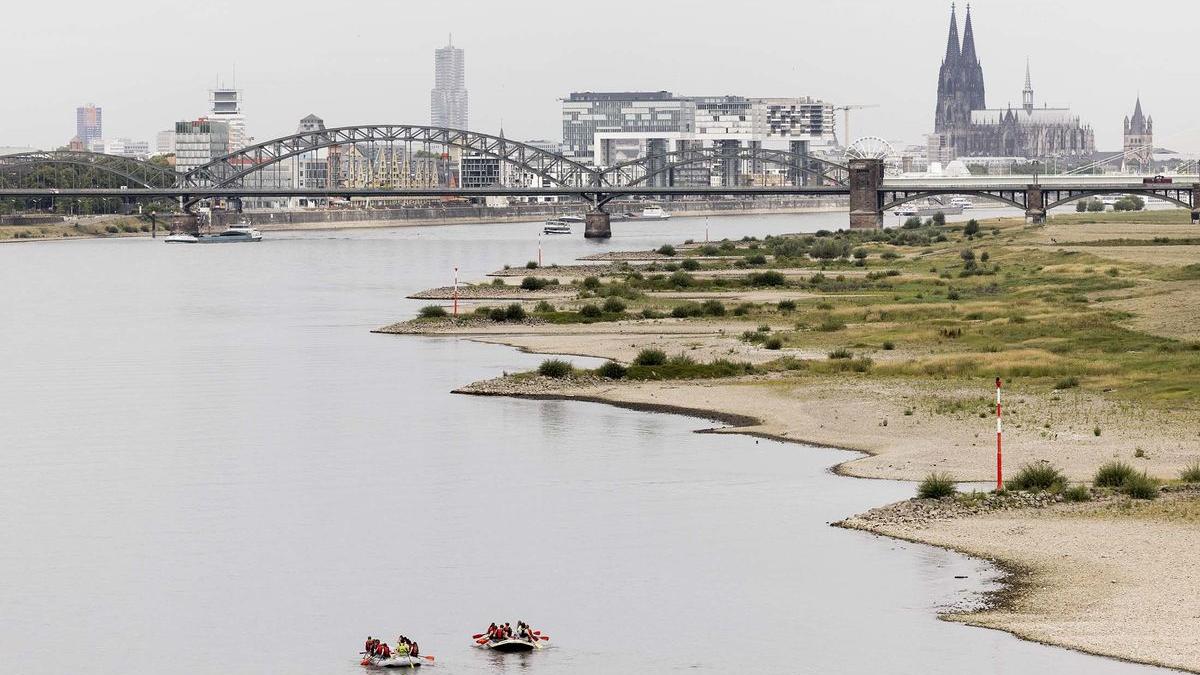
Recent droughts in Germany: when there’s not enough water, it does not necessarily mean there’s not enough drinking water.
The hot and dry years in the 1990s, and particularly the year 2003 have shown that Germany can be hit by low water and drought, in spite of lying in the temperate climate zone. In Germany this exceptionally long dry and hot phase has led amongst other things to increased risk of forest fires, losses in the agricultural sector, restrictions on inland waterway traffic and on the operating times of thermal, hydroelectric and nuclear power plants. The reinsurance company Munich Re estimated the costs of the heat wave of 2003 in Germany at more than EUR 1.2 bn. Others report an agro-economical impact of this drought event for Germany of EUR 1.5 bn, and 15 billion EUR for all of Europe. However, the supply of drinking water was not threatened during 2003.
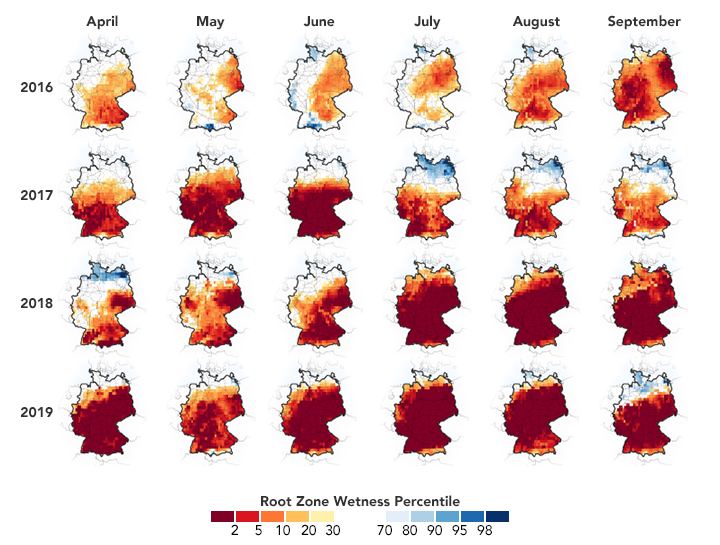
The period 2014 – 2018 was a dry period in large parts of Europe, the worst multi-year soil moisture drought during the last 253 years (1766 – 2018) in especially Central Europe. In Germany, an exceptionally hot summer happened in 2015, when almost 75% of the area of Germany was under at least moderate drought in July. During August 2015, the total area under drought decreased, but the areas of extreme and exceptional drought conditions increased to 22% and 5%, respectively.
The degree to which a region is hit by changes in runoff depends strongly on the size of the change and on the initial situation. Especially regions that presently have an unfavourable water balance and low runoff, such as e.g. the central regions of Eastern Germany, can be strongly impacted by climate change. In these regions, the shift of precipitation from summer to winter leads to further decreases in summer runoff, when the situation has already been difficult in arid years, and causes further water shortages. Even if the results vary between climate models, there is considerable evidence that climate change will increase the risk of arid periods and droughts.
Flood and drought conditions in five large river basins in Germany (covering 90% of the German territory) were estimated from a large number of regional climate model projections. The results for 2061–2100 (compared with 1961–2000) show that many German rivers may experience more frequent occurrences of current 50-year droughts. During the summer there will be much less water available than at present. Between 1990 and 2080 the runoff in summer, depending on the climate model used and the emission scenario considered, will show a decrease of up to 43%. Rivers with a markedly Alpine runoff regime will also be affected by other components, such as accelerated melting of glaciers or permafrost soils and changes in the stability and thickness of snow cover.
However, since Germany’s drinking-water supplies are obtained largely from locally available groundwater resources, and only partly via bank filtration or from surface waters (for example, reservoirs), no fundamental problems in drinking-water supplies are expected even under changed climatic conditions. On the other hand, regional scarcities might occur in areas that suffer extensive periods of drought.
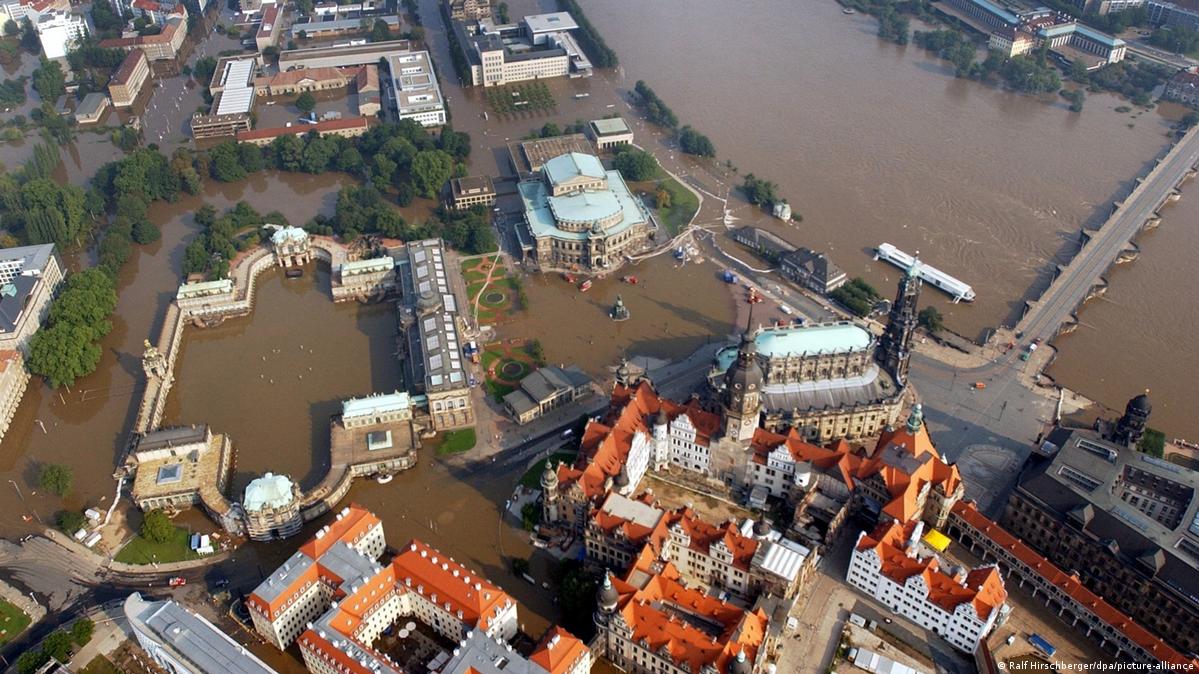
Floods: when too much water puts availability of drinking water in danger.
On the night between July 14 and 15, 2021 the floods hit the Ahr Valley in southwestern Germany. Within a day, the floods turned many people’s lives upside down. Heavy rains transformed small rivulets and streams in the states of Rhineland-Palatinate and North Rhine-Westphalia into torrents. More than 180 people lost their lives and around 17,000 people lost all their possessions. At least 60,000 houses and 28,000 companies were destroyed altogether, causing damages of at least €33 billion.
Last year, Germany marked 20 years since Elbe floods. In 2002, dozens were killed, hundreds injured and tens of thousands left homeless when torrential rains caused the Elbe and other rivers in eastern Germany to burst their banks in one of Europe’s worst natural disasters. In August 2002 a heavy rainfall in Central Europe, caused record-breaking floods in the Czech Republic, Austria and Germany. One of the first cities affected was Passau, in Bavaria. The Danube reached 10.8 meters, its highest level since 1954. On August 17, the Elbe and Weisseritz rivers flooded parts of Dresden’s historic city center, affecting the Zwinger Palace. In 2002, the floods caused major damage across Germany. It left behind destroyed roads, bridges and railroad tracks, as here near Riesa. Houses and dikes were damaged, and harvests were ruined. The Elbe flood of 2002 is still considered the most expensive natural disaster in German history. The total damage amounted to €11.6 billion.
Flooding can lead to contamination of water sources, damage to water infrastructure, and disruption of water supply networks. One of the primary ways that floods can impact drinking water availability is through the contamination of water sources. As rivers and lakes overflow, the pollutants and debris enter the water. This includes sewage, chemicals, and other hazardous materials, which can contaminate the water and make it unsafe for drinking. Another way that floods can impact drinking water availability is through damage to water infrastructure. Floods can cause significant damage to water treatment plants, water supply networks, and water storage facilities. This damage can result in disruptions to the water supply and can take time to repair, leaving people without access to clean drinking water.
The Water Security Law, along with other water management laws and regulations, aims to address these challenges and ensure that the population’s uninterrupted access to clean drinking water is ensured even in times of crisis.
Emergency water supply market: an interesting niche
The emergency water supply market can essentially be split into two large segments: (1) emergency water wells and (2) emergency water equipment.
The market for emergency water wells in Germany is a relatively small but important sector of the water supply industry. Emergency water wells are a critical source of water during times of crisis, when traditional water sources may be unavailable or contaminated. In Germany, emergency water wells are typically drilled into underground aquifers or other water-bearing rock formations. These wells can be equipped with pumps and filters to extract and treat water for drinking and other purposes. Emergency water wells can vary in size, depth, and capacity, depending on the specific needs of the community or region they serve. Despite the relatively small size of the market, the demand for emergency water wells in Germany is expected to grow in the coming years. The Water Security Law as well as increasing frequency of extreme weather events and the need to ensure a reliable and safe water supply during emergencies drives the emergency water wells market. The market consists of a limited number of companies specializing in the design, drilling, and maintenance of these wells.
As for the equipment part, there are various types of emergency water pumps and filters available, including portable pumps, submersible pumps, and large-scale water pumps. These pumps are designed to be used in different situations and can range in capacity from small pumps that can deliver a few hundred liters per hour to large pumps that can deliver thousands of liters per minute. The pump and compressors sector belongs to the most important areas of mechanical engineering in Germany and is estimated at ca. EUR12bn in 2022. The market consists of a number of large players, as well as from the long tail of smaller producers of equipment, engineering and value-add distributor companies.
Winterberg Group in the context of emergency water supply market
Following successful execution of the Buy & Build strategy in water and wastewater treatment market in recent years, Winterberg Group aims to create a holding in the emergency water supply market by consolidating niche Mittelstand companies in this sector. We’re on the watch for players with EBITDA in the range of EUR 1-5M with strong product and services portfolio, experienced management and robust market position.
“The German Mittelstands boasts many highly specialized players which in some way contribute to battle the water crisis. We would like to invest into this macro trend to not only make attractive returns, but also to help countering the effects of this crisis on our country and our lives.”
Fabian Kröher, Executive Director at Winterberg Group