
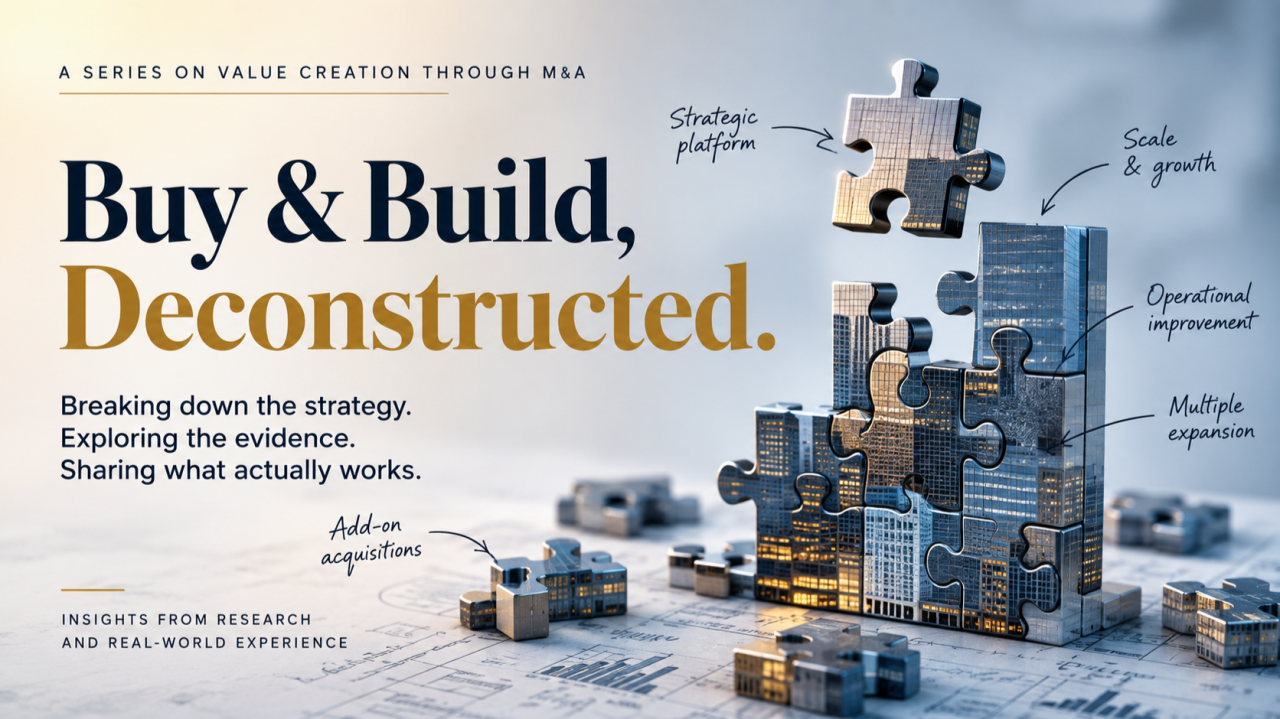
Buy & Build, Deconstructed Vol. 1
Buy & Build is one of the most widely used value-creation strategies in private equity.
But how much evidence is there that it actually works?
This is the first of a series of posts I plan to write on Buy & Build — combining academic research with some observations from my own experience working on buy-and-build platforms.
A good place to start is Hammer, Marcotty-Dehm, Schweizer & Schwetzler (2022), “Pricing and value creation in private equity-backed buy-and-build strategies”, published in the Journal of Corporate Finance.
The authors analyse 3,399 buyouts between 1997 and 2020, supplemented by proprietary PE performance data.
Several of their findings strongly resonate with what I have seen in practice.
1. The right platform is rarely cheap.
The study finds that PE investors pay significant premiums for companies suitable as Buy & Build platforms.
That matches my experience.
The best platform is usually not simply the cheapest company in a fragmented market.
You are looking for a business that can actually absorb acquisitions: strong management, scalable systems, a credible commercial position, sufficient organisational maturity and, ideally, a management team capable of operating a much larger company several years later.
Those qualities tend to be visible to other buyers as well.
So in many cases, you pay for them.
I have increasingly come to think about this as paying not only for the existing EBITDA, but also for the right to consolidate the market around that asset.
2. The economics really start with the add-ons.
Hammer et al. find that, despite higher platform entry valuations, Buy & Build investments generate above-average equity returns.
This also fits what I have seen.
Once a good platform is in place, the economics can change materially.
Smaller businesses are often available at lower multiples. They may have succession issues, limited management depth, no institutional processes or simply be too small to attract larger buyers.
The platform can acquire those businesses and provide something they could not economically build themselves: professional management, finance, IT, procurement, sales infrastructure and access to a larger organisation.
This is where Buy & Build starts becoming much more than simply “doing acquisitions”.
3. Growth and multiple expansion reinforce each other.
Another finding in the paper is that B&B outperformance is associated with both:
- stronger top-line growth
- greater multiple expansion
Again, this feels very familiar from practice.
A successful Buy & Build can create several layers of value at the same time.
You acquire EBITDA.
You grow the acquired businesses.
You realise procurement, sales or overhead synergies.
You professionalise the organisation.
You reduce dependency on individual customers, suppliers, founders or products.
And, perhaps most importantly, you transform the nature of the asset itself.
A collection of €1-3m EBITDA businesses is not valued in the same way as a professionally managed €15-20m EBITDA group with diversified earnings, proper reporting, a second management layer and further acquisition potential.
That difference is fundamental to Buy & Build economics.
But it is also where I think the strategy is often misunderstood.
It is tempting to attribute the success of Buy & Build entirely to operational improvement. In reality, part of the return comes from something much simpler: buying smaller businesses at lower multiples and ultimately selling their earnings as part of a larger company at a higher multiple.
If you build the organisation required to turn a collection of small companies into an institutional-quality asset, the re-rating is arguably part of the value you created.
But it raises an important question for anyone underwriting a Buy & Build today:
How much of the expected return comes from actually making the businesses better – and how much depends on the multiple spread between add-ons and the eventual exit?
In my experience, the best strategies have both.
The multiple arbitrage gives you a structural tailwind.
Operational improvement makes the strategy robust.
And organic growth makes it exceptional.
Over the next posts, I want to dig deeper into each of these components – including multiple arbitrage, integration, acquisition cadence, platform selection and where Buy & Build strategies tend to fail.
Source: Hammer, B., Marcotty-Dehm, N., Schweizer, D. & Schwetzler, B. (2022), “Pricing and value creation in private equity-backed buy-and-build strategies”, Journal of Corporate Finance, Vol. 77, 102285.